Trading standards service plan 2026-2028
Background
Authority structure
1.1 Reading Borough Council became a unitary authority in April 1998 and currently serves a population of 174,200 (ONS Census 2021). The town’s unemployment rate (measured by those claiming Jobseeker’s Allowance) stands at 4.2% (ONS, October 2022), which is above the national average of 3.8% (ONS, February 2023). Reading is a linguistically diverse area, with 77 languages spoken across the borough. It is also identified as the third most unequal city in the UK in terms of wealth, and five of its neighbourhoods fall within the 10% most deprived areas nationally.
1.2 Reading is an urban authority, and the town centre is one of the largest in the South of England, attracting many shoppers and visitors to the area. The town also has a large regional shopping centre and the footfall of the main street, Broad Street, is around 165000 across the week, with over 30000 during the weekends.
1.3 Manufacturing industry within Reading has declined over the years, and it has since developed into a hub for high-technology industries. Virgin Media O2 is among the major companies based in the Borough. The town also contains a single farm and some areas of grazing land.
1.4 There is excellent access to the road system via the M4 (East/West) and the nearby M3 and A34 (North/South). Reading train station continues to provide effective transport links to the town, including services on the Elizabeth line between Reading and London Paddington, which has resulted in Reading being added to the TfL Underground map. In addition, the recently opened Green Park station is believed to further improve commuter access to businesses in that area.
1.5 Reading is a market town, with its main market operating four days a week, alongside a thriving twice-monthly Farmers’ market where local producers sell their own produce. The town also hosts two weekly food markets, as well as an annual chilli festival and a specialist food festival.
1.6 The town also hosts several festivals and cultural events that attract both visitors and itinerant traders. The most notable of these is Reading Festival, which is the second-largest music festival in the UK after Glastonbury.
Directorate structure
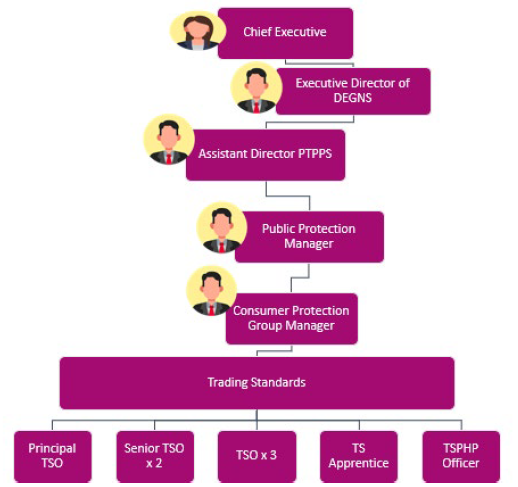
1.1 The Council has an approved constitution setting out how the Council operates, how decisions are made, and the procedures followed to ensure that these are efficient, transparent and accountable to local people. A copy of the Council’s constitution is available at: Constitution of the Council October 2025
1.2 The Scheme of Delegations sets out who is responsible for making decisions, including the authority for the service of enforcement notices.
1.3 A copy of the Scheme of Delegations is available at: 2002-2010-Delegations-Register.pdf
Objectives
Purpose of the trading standards service
2.1 To provide a fair and safe trading environment for the consumers and businesses of Reading through engagement, education, advice, enforcement, and collaborative working.
2.2 Our purpose is mainly derived from statutory responsibilities to enforce over 200 pieces of primary and secondary trading and regulatory laws.
2.3 It is worthy to note that the Service cannot routinely obtain refunds or compensation for consumers; the small claims court and County Court structure is in place for consumers to obtain redress from traders with whom they are in dispute. Opportunities to seek compensation orders for consumers involved in prosecution cases do arise, but these are only secured on conviction, which can take several years, or longer, to process through the criminal courts.
Service priorities
Service priorities
- Support sustainable economic growth by providing the best advice to businesses to ensure they trade fairly and safely.
- Contributing to Public Health and Wellbeing
- Identify and tackle problem traders.
- Identify and tackle illegal tobacco and vape retailers
- Protect vulnerable consumers to help safeguard their independence, health and well-being.
- Work with internal and external partners on food chain integrity
Activities
- Investigating complaints
- Visits to premises, website checks and advertisement monitoring
- Projects and Market Surveillance
- Sampling and testing
- Test purchases and seizure
- Responding to other intelligence
- Formal enforcement action
- Guidance to businesses and Primary Authority advice
- Partnership with national Citizens Advice Consumer Service,
Existing resource focus areas
- Investigating Rogue and Doorstep Trading
- Monitoring And Investigating Second Hand Car Sellers
- Safety related counterfeit products
- Primary Authority Partnerships
- Age Restricted Sales of Alcohol and Nicotine
- Weights And Measures Related to The Cost of Living Crisis
- Product Safety
- Illegal Tobacco and Nicotine Products
- Victims Of Scams
- Food Standards
Other focus areas
- Petroleum And Explosives
- Other Age Restricted Products and Services
- Food And Animal Feed Labelling and Composition (See Food Service Plan)
- Animal Health, Welfare and Disease Control
- False Claims, Misleading Prices
- Non-Safety Related Counterfeit products
- Issues Relating to The Climate Emergency
Measured objectives that link directly to specific corporate objectives
Promote more equal communities in Reading
Trading standards service priorities
- Protect vulnerable consumers to help safeguard their independence, health and well-being.
- Contributing to Public Health and Wellbeing
- Identify and tackle problem traders.
- Identify and tackle illegal tobacco and vape retailers
Connection and activities
practices, supporting victims of scams, improving health outcomes.
Activities include: Investigating complaints, responding to intelligence, test purchasing, providing advice and guidance, formal enforcement action.
Secure Reading’s economic and cultural success
Trading standards service priorities
- Support sustainable economic growth by providing the best advice to businesses to ensure they trade fairly and safely.
- Identify and tackle problem traders.
- Identify and tackle illegal tobacco and vape retailers
- Work with internal and external partners on food chain integrity
Connection and activities
Supporting businesses to comply with regulations fostering a fair trading environment, which boosts consumer confidence and contributes to a thriving local economy and cultural vibrancy.
Activities include: Visits to premises, website checks and advertisement monitoring, investigating complaints, sampling and testing, test purchases and seizure, formal enforcement action, guidance to businesses and Primary Authority advice.
Deliver a sustainable and healthy environment and reduce Reading’s carbon footprint
Trading standards service priorities
Support sustainable economic growth by providing the best advice to businesses to ensure they trade fairly and safely.
Connection and activities
Ensuring integrity in the food chain and promoting sustainable business practices contributes to environmental goals and public health.
Activities include: Visits to premises, website checks and advertisement monitoring, investigating claims and complaints, enforcing the single use vape ban, projects on environmental and sustainability issues.
Safeguard and support the health and wellbeing of Reading’s adults and children
Trading standards service priorities
- Protect vulnerable consumers to help safeguard their independence, health and well-being.
- Contributing to Public Health and Wellbeing
- Identify and tackle problem traders.
- Identify and tackle illegal tobacco and vape retailers
Connection and activities
Trading Standards plays a direct role in protecting public health, through enforcement of age-restricted products and services, counterfeit products, unsafe products and supporting victims of scams.
Activities include: Investigating complaints, respond to intelligence, sampling and testing, test purchases and seizure, Formal enforcement action.
Ensure Reading Borough Council is fit for the future
Trading standards service priorities
- Work with internal and external partners on food chain integrity
- Support sustainable economic growth by providing the best advice to businesses to ensure they trade fairly and safely.
Connection and activities
A modern, responsive Trading Standards service that collaborates effectively and supports innovation contributes to a future-ready council.
Activities include: Guidance to businesses and Primary Authority advice, Partnership with national Citizens Advice Consumer Service, accessing regional working and support.
2.4 Regional collaboration plays a significant role in achieving our aims through Trading Standards South East which features coordinated project work, shared intelligence, and support from the regional enforcement team and the illegal tobacco coordinator.
2.5 There are specific plans required by the Food Standards Agency to be produced setting out our approach to the delivery of Food Standards, Feed Standards (animal feed) which are included in the Food Service Plan. An Under-Age Sales Enforcement Programme is also legally required. These are published annually on the council website.
How the service works
2.6 The Service operates on an “intelligence informed” basis. This means that the Service can be agile and respond at pace to emerging issues but, when resources allow, conduct market surveillance to establish sector specific compliance. The intelligence, in the main, derives from referrals and notifications (complaints) received from our partner, the Citizens Advice Consumer Service, but can come in via internal and external partners such as Councillor & MP enquiries, other Council services, the Police, HMRC, Defra, OPSS and so on.
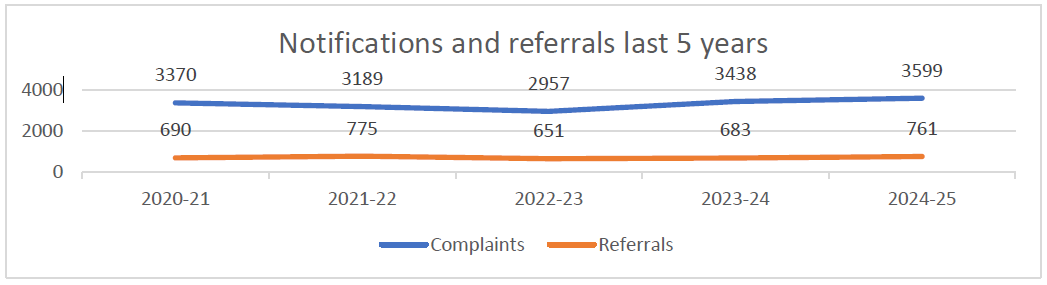
2.7 The analysis of complaints informs the areas on which the Service concentrates and takes account of the strategic priorities of both the region, TSSE, and at national level via the NTS (National Trading Standards) (see annex).
2.8 The Service receives many more notifications and referrals that it can manage and applies a triage process to ensure resources are targeted as efficiently as possible to tackle the greatest harm. Every complaint is reviewed.
2.9 Investigations into complaints are carried out in accordance with the Council’s Enforcement Policy. Challenges with legal processes and the court backlog mean that alternative routes to compliance are sought where possible, including licence reviews, closure orders and formal notices. Cases involving fraud in particular are complex and can take several years to reach court.
Enforcement approach for its focus areas
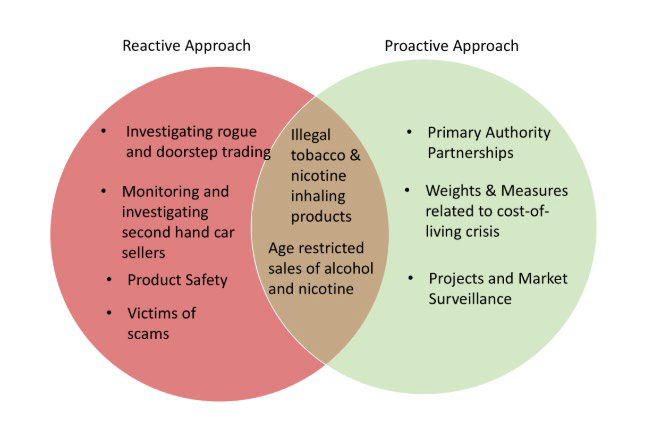
The service broadly takes the following approach with its focus areas:
Performance
3.1 The Service completes the ACTSO Outcomes & Impacts report on an annual basis and reports on the Corporate Objectives.
3.2 Funding for the Service is allocated via the Council budget and a grant from Public Health funds the CAP/Tobacco role. Income is generated via licensing of petroleum and explosives and the Primary Authority Scheme. An apprentice has been appointed via direct funding by the Department of Health and Social Care for the next 40 months (from October 2025). There is also a Trading Standards Officer post embedded in and funded by the Private Sector Housing Team, which specialises in estate agency, letting agency and tenancy law related to trading standards offences.
Annex
TSSE Priorities for 2026/27
Protection of Victims of Crime
Tobacco Control
Fair Trading
Doorstep Crime
Product Safety
Animal Health
Food – covered by Food Service Plan
The NTS priorities for our national Control Strategy for 1 April 2026 – 31 March 2027 will be:
- Doorstep crime and cold calling (including energy fraud).
- Lettings (England only).
- Mass marketing fraud/scams.
- Illicit and underage sale of vapes (England only).
- Illicit tobacco.
- Used cars.
- Intellectual property.
- Other fair trading issues.
- Estate agency.
- Animal feed work.
NTS will also have the following cross cutting themes and enablers, as they impact on each priority area:
- eCrime and the use of social media/online platforms.
- Serious and organised crime.
- The cost of living crisis.
Last updated on 25/03/2026
Trading standards service plan 2026-2028