Tenant engagement strategy 2025-2030
1. Introduction – Cllr Yeo, Lead Member for Housing
We want to improve our housing services better by listening to you, our tenants. Your experiences help us understand what’s most important to you and where we need to improve. That’s why we’re committed to hearing your feedback and acting on this to improve services.
We welcome all tenants to get involved, no matter how long you’ve been a tenant with us. You know your homes and communities best, so your ideas are key to helping us make positive changes.
Listening is just the first step. We’re here to act on your priorities, whether it’s improving the timeliness of repairs, ensuring your homes are safe, supporting those who need extra help to access services or making it easier to give us feedback when things go wrong.
There are many ways for you to have your say including joining tenant panels or sharing feedback in ways that suit you. We want to be open, transparent, and make sure your input shapes the services you rely on.
By sharing your thoughts, you help us make real changes that benefit everyone in our community. Together, we can build housing services that meet your needs.
Thank you to everyone who has already shared their ideas with us. Your input has been invaluable, and we’re excited to keep working with you to deliver the changes that matter most.
2. A tenant’s introduction to the 2025 Tenant Engagement strategy. – Pat Watson – member of the TACT Scrutiny Panel, Block Cleaning Panel and The Tenant Improvement Fund Panel
As a tenant of Reading Borough Council, I believe we should be at the heart of everything that Reading Brough Council does as a landlord. We all want to feel proud of our homes and communities, and that starts with having a real say in the decisions that affect us.
RBC has a responsibility to listen to tenants and respond in a timely and respectful way. A welcome improvement to tenant’s consumer rights is set out in new government regulations with a bigger focus on safety in homes, in particular higher risk buildings, and improved housing conditions. There are five important priorities set out in this Tenant Engagement Strategy which are Information & Communication, Tenant Feedback, Recruitment & Support of Tenant Volunteers, Engagement Structures & Opportunities and Complaints. There are many opportunities for tenants to be engaged ranging from small amounts of volunteer time such as surveys and focus groups to more in-depth scrutiny reviews that take several weeks with full training provided. All volunteer time is tailored to suit the individual tenant.
I have assisted with many of the tenant groups over the years that I have been I involved and have a genuine interest in helping other tenants get the best from their housing. I have learnt new skills, and learnt a lot about housing and how Reading Housing Services works. I feel through working with other likeminded tenants and RBC staff we have made a difference to tenants’ homes, neighbourhoods and the services they receive from RBC Housing. This Strategy will help to build on the work we have been doing, and I hope more tenants take the opportunities available.
About Reading
3.1 Reading as a place
- Regional Hub: Reading is a key centre in the Thames Valley, known for retail, leisure, and nightlife.
- Population: 178,196 residents (67,700 households) in the borough, with 233,000 in the surrounding area.
- Diversity: 46.5% of residents are from Global Majority groups, second highest in the South-East after Slough.
- Inequality: Wealth disparity is significant, with affluent and deprived areas close together.
- Economic Strength: Top 5 in the UK for growth and workforce productivity, top 10 for business activity and private jobs.
- Educated Workforce: Among the UK’s top 5 for workforce qualifications.
- Housing Costs: Median house prices tripled since 2000, reducing affordability for low-income households.
- Housing Support: Higher rate of households owed housing help than national and regional averages.
- Homelessness: Fewer households in temporary accommodation than the UK average, but 42 rough sleepers in 2024, second highest in the South-East.
3.2 Reading Stock:
Reading Borough Council is proud to be a landlord with a Social Housing Stock of 7,071 properties that it owns, including:
- 5,355 general needs properties
- 341 sheltered housing units
- 128 HRA-owned temporary accommodation units
- 1,247 managed by Affinity Housing (Private Finance Initiative)
The Council’s Housing stock is made up of:
- 45% houses (mostly 3 bedroom, 33% of total stock)
- 36% flats (21% 1 bedroom, 13% 2 bedroom)
- 19% bungalows (6%), bedsits (7%) and maisonettes (6%)
The Age of the Housing Stock:
Stock ranges from 1900s to 2020s, including new builds. 73% built between 1950s and 1970s (1950s: 29%, 1960s: 28%, 1970s: 16%)
4. National & Regional Context
Reading Borough Council’s duties as a social landlord are set out in a range of legislation, regulations and standards set by Central Government. This section summarises the key areas that relate to our engagement with tenants.
4.1 Social Housing White Paper 2020 and Social Housing Regulation Act 2023
The Charter for Social Housing Residents: Social Housing White Paper 2020 (SHWP) aimed to reform consumer standards to ensure residents live in good quality homes, have access to redress as necessary and are safe and listened to. As a social housing resident, you should expect:
- To be safe in your home
- To have your voice heard by your landlord
- To know how your landlord is performing
- To have a good quality home and neighbourhood to live in
- To have your complaints dealt with promptly and fairly
- To be treated with respect
- To be supported to take your first step into ownership.
The new consumer standards are:
- The Safety and Quality Standard which requires landlords to provide tenants with safe and good quality homes and services. Landlords must deliver repairs, maintenance and planned improvements in an effective, efficient and timely manner.
- The Transparency, Influence and Accountability Standard – landlords must be open with tenants and treat them with fairness and respect so they can access services, raise complaints, influence decisions and hold them to account.
- The Neighbourhood and Community Standard – requires landlords to engage with other relevant parties in the community so that tenants can live in a safe and well-maintained neighbourhood, embedding tenant voices within decision making structures.
- The Tenancy Standard – sets requirements for the fair allocation and letting of homes and for how those tenancies are managed and ended. Homes must be allocated and let in a fair and transparent way by the landlord.
- The Competence and Conduct Standard – a new standard that aims to introduce a national framework for promoting high standards and professionalism within the social housing sector. The consultation on this standard ran from February 2024 to April 2024 and as at the time of drafting the strategy, we are waiting on the results of the feedback received.
4.2 The Tenant Satisfaction Measures
Forming part of the Transparency, Influence and Accountability Standard, the Tenant Satisfaction Measures are a set of both performance and perception measures. All landlords are now required to report on how they are performing each year. This will include a Tenant Satisfaction Survey carried out each year which includes set questions for tenants to respond to.
4.3 1985 and Housing Act 1996
Local authority landlords must have arrangements to inform and consult with both secure and introductory tenants who are likely to be substantially affected by changes in housing management. Housing management matters includes the provision of services, building maintenance, improvement or demolition of housing and any services or amenities in connection to such housing.
4.4 The Housing Ombudsman Service (HOS)
Since the 1st April 2024 the Housing Ombudsman has introduced a revised Complaints Handling Code including stricter timescales for replying to complaints. To reflect this, we have updated our Housing Complaints policy to align with the Housing Complaints Policy.
4.5 Building Safety Act 2022
The Building Safety Act 2022 requires social landlords to have a Resident Engagement Strategy that promotes the participation of residents in the making of building safety decisions. It also requires that the Strategy is reviewed at set times and revised if needed.
4.6 The New Building Safety Regulator
A new Building Safety Regulator has been set up by central government. The Regulator sets out clear expectations for social housing landlords especially for high-risk homes such as buildings over a certain height and sheltered housing schemes. There is a requirement for a Resident/Tenant Engagement Strategy which sets out how the landlord will include/engage with anyone over the age of 16 who lives or who owns a residential property in building safety decisions, as well as who the tenants can contact about their safety concerns.
5. The Tenant Engagement Strategy: Vision and Priorities
Why have a strategy?
A strategy allows us to plan effectively, establish clear goals, and prioritise how we are ‘supporting the life that matters to you’ which is the purpose we aspire to in the Housing & Communities service. It serves as a guide to deliver the services you need and expect. It provides us with a clear vision and sense of direction.
Who is the strategy for?
This strategy is designed with you in mind—our tenants and future tenants. Your feedback drives the changes and improvements we make. To uphold our commitment, our teams will actively listen, communicate clearly, and engage you at every stage of their work.
What does the strategy mean for me?
It outlines the way in which we as your landlord will engage with you, what we’ll engage with you on and what we aim to achieve by doing this. You will have the opportunity to meet new people, be part of the Tenant Participation team and you could learn new skills that can transfer over to other areas of your life.
What will being involved achieve?
Our involved tenants have made a significant positive impact for all our tenants, because of their work to date. This has included scrutinising and making recommendations to improve services such as repairs and complaints. The Tenant Improvement Fund has also made a significant positive impact in local areas by improving facilities such as providing bike sheds, additional security gates, improving parking and communal garden spaces across various sites.
Our shared vision & key commitments
We aim to keep you informed, engaged and give you opportunity to shape the services that we offer. Our goal is to be recognised as a landlord that places you at the centre of everything we do.
6. The Vision – what will Tenant Engagement look like for Reading Borough Council in 2030
Working with our involved tenants we have identified a vision for Tenant Engagement:
“Tenants are at the heart of everything we do; all tenants know their views are welcomed, respected and acted upon, and our properties and estates are places our tenants are proud to call home”
As a social housing landlord, our main goal is to ensure tenants can share their views on our services and trust that their input will influence decisions about their homes and communities. Building trust is crucial — tenants won’t engage if they feel ignored. This strategy focuses on improving feedback by clearly reporting what tenants have said, how we’ve responded, and the outcomes of their input and then assess the impact this has had. It will also enhance and expand opportunities for tenants to have their say. Please see appendix 3 which outlines how the vision and priorities were chosen.
This vision translates into 5 clear priorities that the Housing Service will focus on until 2030.
- Priority 1 – Information and Communication
How we keep each other updated on what is happening, what is changing and providing a wide range of channels to get in touch. - Priority 2 – Tenant Feedback
How we collect, record and utilise our tenant’s feedback to improve the services we provide. - Priority 3 – Recruitment and support for engaged tenants
How we keep you informed of the different ways you can have your say, how we can support you to do so. - Priority 4 – Meaningful engagement structures
The different ways tenants can engage with the service, participate, give feedback, raise concerns, and influence services, decisions and policies. - Priority 5 – Complaints
How we process your complaints, the standards we work to and how we use what you tell us to improve the services for all tenants.
Priority 1 – Information and Communication
To review and develop the information, communication and methods used when reaching out to all tenants, including developing a communication strategy to meet tenants needs.
Improving Communication with Tenants
Housing Services currently send out the following communications to all tenants:
- Annual Report (once per year) a report published on the website and sign posted to in Your Housing.
- Your Housing (two editions a year), our landlord magazine to all tenants which is currently written and produced by Housing Services.
- Love Your Block newsletter (two a year) sent to all tenants in receipt of the cleaning service. This is written and produced by tenants from the Building Cleaning Panel with articles and assistance from Housing Services.
- Wensley News (four a year) goes to all households in the Coley Park area affected by the new build housing.
- Ad hoc letters, flyers, surveys, Consultation and other information as and when they are necessary.
We have many notice boards across our estates and in all of our blocks of flats. Tenants have told us they feel the estate notice boards are underused and want more up-to-date, relevant information. For example, notices of when the Housing Officer Estate Walkabout is held, the different opportunities to get involved and how to do so and providing useful contact numbers for services like the bulky waste and Anti-Social Behaviour services as well as information on what is happening on the local estate. Both tenants and staff have noted that communication is often one-way, and new ways to gather and respond to tenant feedback need to be explored, and our new IT system may allow us to tailor communication to tenants’ preferences.
Tenants have highlighted areas where communication can improve, such as:
- Sharing clear local information (e.g. service standards).
- Consistently keeping them informed about repairs, maintenance, and appointments (e.g., gas inspections, texts for repair appointments).
- Using various methods like texts and emails while considering tenants without internet access.
- Ensuring communication meets the needs of tenants from diverse backgrounds including those whose first language isn’t English and communities.
This plan ensures clearer, more inclusive communication that is suited to our tenants needs.
Priority 2 – Tenant Feedback
To develop and improve processes for tenant feedback regarding our services and how we record and respond to it to deliver services.
Improving Consistency in Tenant Engagement and Feedback
Housing services carry out a range of engagement activities throughout the year to get tenants’ views on services, estates and properties. This includes both the Annual and Tenant Satisfaction surveys, transactional surveys, focus groups and tenant panels and complaints.
Feedback and results are reported in our publications including the Annual report, Your Housing, Love your Block and on the website, as well as writing directly to tenants who have responded.
To date there hasn’t been a consistent process for showing how tenant feedback influences decisions. The Tenant Engagement Team uses a planning and assessment tool to look at the positive and negative impact of their activities, but this needs to be applied across all services. We have created a standard consultation form, along with a feedback questionnaire to help plan our engagements and capture feedback from these activities, to make sure we get the best outcomes. We hope this will encourage more tenants to talk to us, by showing you that your views make a difference. We want to be able to demonstrate the value of tenant feedback, and the positive impact this has in your homes and communities.
Priority 3 – Recruitment and Support
We aim to create clear guidelines and tools to support tenants in their roles. This includes explaining the opportunities available, the training and support on offer and any equipment needed.
Improving Tenant Recruitment, Support, and Engagement
The Tenant Engagement Team has developed various ways for tenants to get involved, from informal surveys to more extensive roles like tenant panels. Support includes training, mentoring and help with transport or caring responsibilities. Opportunities are advertised in publications (e.g., Your Housing, Love Your Block), the Annual Report and through direct mailings.
To expand involvement, we’ll explore new digital consultation platforms tools, surveys via text message, improve awareness of involvement opportunities and act on tenant feedback requesting local face-to-face activities and diverse networks.
Better training opportunities, such as the Tenant Academy, will continue to provide tenants with skills for both involvement and personal development, including career progression. Our existing engaged tenants will also act as ‘buddy’ for all new engaged tenants looking to join TACT or the Tenant Voices, to help their development, training and to settle into the group easily. This approach will empower tenants, build meaningful engagement, and support personal development. Our menu of engagement is outlined below in section 7.
Please see Appendix 4 for the full Menu of Engagement.
Priority 4 – Meaningful Engagement Structures
Work with our tenants and staff to develop involvement opportunities to meet tenants needs. To ensure tenancy involvement is embedded within service areas, allowing tenants to inform, challenge and scrutinise service delivery, governance and policy development.
Improving Tenant Engagement Structures and Opportunities
Tenants currently have various ways to provide input, including:
- TACT (Tenants and Council Together): Reviewing key areas like welfare reform, repairs, fire safety and estate services.
- Block Cleaning Panel: Monitoring cleaning standards and performance.
- Tenant Improvement Fund Panel: Overseeing project selection and spending.
However, some areas need improvement:
- Refresh tenant involvement in repairs and planned maintenance which has previously been inconsistent.
- Tenant Engagement and scrutiny reviews being reported into the Housing Service’s governance structures (e.g., council committees) needs to be formalised.
- During the pandemic, use of online opportunities were developed to ensure tenants views could still be captured but this isn’t suitable for everyone. A variety of ways to reach tenants will be developed including building on online opportunities but also in person events, both centrally and on estates as well as by phone and post. New tools such as digital consultation platforms offer potential for wider and more meaningful tenant involvement.
This plan aims to embed tenant engagement in all service areas and ensure tenants voices help to drive up service standards.
Priority 5 – Complaints
Ensuring tenant engagement in how we receive, respond and learn from complaints. Use this information to develop and implement our Service Improvement plans.
Current Situation
The Housing & Communities Service follow the new Complaints Handling Code which is a requirement from the Housing Ombudsman. However, discussions with tenants have identified the lack of a consistent process for tenants to monitor complaints and show how the service learns from them.
The Tenant Engagement Team will work with engaged tenants to create a new complaints panel to review performance, challenge practices and provide feedback. This panel will work with the Customer Relations Team and Housing Policy & Quality Assurance Manager. Currently, one tenant represents the Housing Ombudsman Service panel and shares updates with others.
Reading Borough Council has a new Service Improvement Plan, and tenant involvement is key to overseeing its progress and outcomes.
7. Menu of Engagement
To build on the opportunities in place, a menu of engagement will be published that sets out the involvement options for our tenants. Our opportunities for involvement are set out below, in various levels, based on how involved you would like to be:
- Inform
Information & Resources: Sign up for our Sounding Board to stay informed with newsletters, training opportunities, surveys and updates on tenant engagement events. - Involve
Local Engagement: Work with other tenants in your community to improve your local area. - Consult
Central Engagement: Help shape our services by participating in two-way communication between Reading Borough Council and tenants. - Collaborate
Strategic Engagement: Contribute to high-level decisions by sharing feedback and attending Committees & events.
Engagement Model:
The Tenant Engagement Model below outlines how you can get involved and how your views and ideas will help shape service decisions. The Tenant Engagement Team supports tenants who want to participate and ensures a strong culture of tenant involvement and how we develop and deliver services across the organisation, and how we ensure that the tenant voice is heard at all levels of governance within our service.
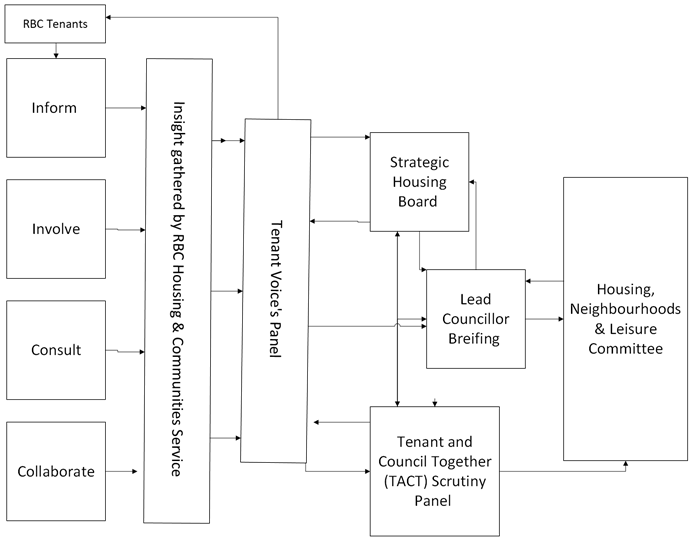
The Tenant Voice’s panel will be set up following the relaunch of the strategy in 2025.
HOW THE MODEL WORKS
The Tenant Engagement Model shows the ways in which tenants will be informed, involved in, consulted on and collaborated with. To have your voice heard and your views expressed in whichever way suits you.
| Inform (Information & Resources): Complete a survey Love your Block The Sounding Board | Involve (Local Engagement): Mystery Shopper Block Champion Estate Walkabouts Community Centre Drop ins High Rise Forum |
| Consult (Central Engagement): Building Cleaning Panel Member Tenant Quality Mark Tenant Improvement Fund | Collaborate (Strategic Engagement): Tenant Voice’s – group member Tenant And Council Together (TACT) Scrutiny Panel Member |
Ways to get involved:
A variety of involvement opportunities form part of our Tenant Engagement Model and have been developed based on what you, our tenants have told us. Some tenants can give a significant and regular time commitment, while others want to be able to dip in and out on issues that affect you, when you have the time. This will include offering all opportunities for involvement in our panels both in person and/or by becoming a digital member, allowing tenants to join online.
In addition to the range of involvement opportunities, we also listen to your voice through other ways such as surveys we carry out, the complaints and compliments we receive, the satisfaction data we collect and through our interactions on social media.
We are also committed to ensuring that those of you who become or are already involved gain wider benefits, some of which can sometimes be overlooked. These can include increasing knowledge and learning new skills, networking with other tenants and organisations, building friendships and feeling more closely connected to your communities. Above all, we want those involved to enjoy their roles, see the value of their contribution and feel their views are respected.
The information below outlines the different ways of getting involved and indicates how much time they will take and what level of engagement they are:
Complete a survey
Inform – Low time commitment
We carry out surveys throughout the year. One survey is the Annual Tenant Satisfaction Survey, which is a requirement for all social housing landlords. It enables us to understand what tenants think of our services and lets tenants compare our performance with other landlords. An independent company carries out this survey, so your answers are confidential (unless you state otherwise). We also carry out other surveys via text, post, phone and email to get tenant views on our services.
Love Your Block
Inform – Low time commitment
Love your block is a tenant-led bi-annual newsletter. All tenants who live in a block that receive cleaning services will receive this, to include useful information and any updates to the service. This offers an opportunity for tenants to become involved in the block cleaning panel.
The Sounding Board
Inform – Low time commitment
The sounding board contains a list of everyone who wants to get involved, how they would like to be involved and any areas of interest. For example, a specific interest in the neighbourhood, the repairs service or becoming a member of one of our panels. When an opportunity to give your views comes up, we match the opportunity with your preferences. If there is a match, we will let you know and you decide if you would like to be involved or not.
Mystery Shopper
Involved – Medium time commitment
Posing as a customer, you will help us understand the experience of our customers when they first contact us. You will be given full training to help you know what you should ask on the phone or in an email, or what you should do on the website or in person. There will then be a short form for you to complete to report on your experience.
Block champion
Involved – Medium time commitment
Block champions keep an eye on their apartment blocks and report any issues such as litter, repairs and concerns around the standard of cleaning or building safety. As a champion, you will be issued with a handbook and reporting sheets so you can record any problems to report.
Estate Walkabouts
Involved – Low time commitment
Estate walks happen regularly across the Borough and are advertised to encourage tenants and residents to join in. They’re a great way to check and improve standards in our neighbourhoods. The walks give tenants a chance to share what’s happening in their area and suggest improvements. For many, it’s also the first step to getting more involved.
Community Centre Drop ins
Involved – Low time commitment
These are held in local community centre buildings. Tenants can come along and have their questions answered by a member of the housing team. Staff attend from various departments, for example: housing management, money advice, antisocial behaviour team, and the safer communities team.
High Rise Forum
Involved – Low time commitment
The High Rise Forum will be open to tenants living in high-rise properties and offers a chance to address your specific needs and concerns. High-rise living comes with unique challenges, and it’s important for us to listen to those who experience it firsthand. The forum will also serve to keep tenants informed about any planned works or improvements and provides an opportunity for the group to share ideas and discuss solutions together.
Building cleaning panel member
Consult – High time commitment
The Building Cleaning Panel is a group of tenants who meet with housing management and the building cleaning service to monitor the standard of cleaning in communal areas across our blocks of flats. Panel members look at data and performance information and check and challenge the standards of the cleaning service. Members could also carry out mystery shopping block inspections to look at the standard of cleaning across the blocks.
Tenant Improvement & Decent Neighbourhood Fund (TIF) Panel
Consult – High time commitment
The TIF is a pot of money available for tenants and officers to identify small scale environmental projects to benefit their local area. The TIF panel is a group of trained tenants who review and approve project bids to ensure they are suitable, properly funded and based on thorough tenant consultation. Supported by Housing Management, the tenants make the final decisions on funding projects each year. The panel meets at the start of the financial year to choose projects and then holds regular online meetings to monitor their progress and review impact reports after completion.
Tenant Quality Mark
Consult – Medium time commitment
This includes looking over leaflets, letters, online publications and other material to make sure it is easy to understand and get our message across clearly. Once it has been reviewed and approved by the panel, the document/content will receive a ‘Tenant Quality Mark’ stamp. You can review documents from your own home and in your own time.
Tenant Voice’s – panel member
Collaborate – High time commitment
Housing has a long history of involving tenants in the decisions it makes regarding their homes and local community. The pandemic made us rethink our ways of working and more services moved online in response to lockdown. Now is a good time to look at how we engage with our tenants, how we respond to what they tell us and identify the ways that tenants wish to give their views. This is a new panel that will oversee the drafting of tenant engagement strategy, conduct research, identify appropriate actions and monitor the progress.
Tenant And Council Together Panel (Tact)
Collaborate – High time commitment
Tenant and Council Together (TACT) is our tenant scrutiny panel. It consists of a group of trained tenants who identify areas of the Housing Service where they would like to carry out a deeper performance assessment on. This involves looking at data, interviewing senior and front-line members of staff and tenants and producing a report with recommendations for improvements which is submitted to senior housing managers. Following the introduction of the TSMs and through out the creation of this strategy, there have been 2 key areas tenants want to focus on, Repairs & Maintenance and Complaints and on both of which scrutiny will be welcomed.
Tenant Involvement: Attractive and Accessible to all
We want you to get involved in a way that works best for you, based on your time, circumstances and practical needs, such as childcare, travel, disabilities, or internet access.
To ensure no one is left out, we’ll offer flexible ways to get involved and ask how we can remove any barriers you face. Financial challenges won’t be a blocker—we’ll reimburse reasonable expenses and share details on how we can support individuals and groups financially.
We understand that tenants have busy lives, and it may be difficult to commit the time to join panel meetings in person so these will be set up to allow tenants who wish participate remotely by joining the meeting on line. This offer will be made available for all the tenant activities including TACT or Tenant Voice’s.
The Tenant Engagement Team can also help groups apply for grants and funding to support their community work. Additionally, we will seek ways to create social-value funding, including contributions from contractors and staff volunteer days to back community-led projects.
Training & Support for Involved Tenants
We understand that having the right knowledge is key to playing an active role. Along with providing information on the Housing Services performance, we will create and share a training programme for those who want to get more involved.
We also recognise that many of you have valuable skills and expertise that can benefit the Housing Service and other tenants. We will make efforts to tap into these skills and encourage sharing them with others.
Currently, we offer a variety of training options, the majority of which are online, through Four Million Homes which cover several different areas which are specific to the housing service. The Tenant Engagement Team also deliver a number of bespoke training sessions specific to the engagement methods such as how to conduct block inspections, mystery shopping and we will be revamping the service-lead 12-week Tenant Academy Course.
Please see Appendix 5 for our full training offer
We plan to expand this training and will consult with our involved groups on their needs. Additionally, we will broaden our training programme to include digital and other transferable skills for everyday life.
8. Equality, Diversity & Inclusion: A strategy for all
We will make sure that this strategy and our tenant involvement activities are accessible and fair, giving everyone the same opportunity to succeed in their role, be heard, and feel part of their community. We understand that sometimes this means doing things differently for some people.
To do this, we need to get better at updating the data we collect about our tenant and those living in our properties and ensure that we use this data to better understand their diverse needs and improve how we engage and deliver services for all.
Our Tenant Engagement actions will include steps to identify and overcome any barriers that tenant may face. We will reach out to different groups and individuals to connect with them and address any challenges.
We also expect everyone involved in tenant activities to promote equality and encourage participation from all parts of our community, respecting each other and each other’s situations.
Through RBC’s Equality Strategy and our Housing Annual Report, we will track and report regularly on equality, diversity, and inclusion data about our tenants and using it to improve how we meet their needs.
9. How Will We Know It’s Working?
We will know our efforts are successful if you tell us you’re happy with the services we provide and that we are meeting your needs. To ensure we are able to evaluate our engagement opportunities and the outcomes they have had the service will conduct feedback surveys following each Consult and Collaborate level engagement with the tenants involved, to understand how it went, and what could be done better. This feedback will be reviewed regularly as it is important to us to continually improve.
In addition, we will follow up on all engagements with impact assessments, to understand what positive impacts the work has had, and will regularly feed this back to the tenant power / voice panel, and in our publications such as ‘Your Housing’ and in our Annual report to Tenants, and report this into the Housing Neighbourhood & Leisure Committee Annually.
10. Plans to Support Our 5 Key Commitments
Based on what tenants have told us, we’ve outlined actions to support our 5 Key Commitments and achieve our shared goals.
Priority 1 – Information and Communication
- Tenant Consultation: Ask our Sounding Board tenants how they prefer to receive and provide information, what details they need and design a communication strategy to meet these needs. Using our online consultation platforms to capture including clearly outlined communication options, frequency and methods, including consulting on service standards.
- High-Rise Buildings: Work with tenants in high-rise buildings to develop a tailored engagement strategy for fire and building safety.
- Service Communication Plan: Create a Landlord Service Communication Plan, including digital communication options.
- Publications: Continue producing “Your Housing” twice a year and an Annual Report but review their effectiveness in reaching all tenants.
- Tenant Engagement: Reintroduce the Tenant Quality Mark (Reader’s Panel) and train tenants to help design and produce communications like “Your Housing.”
Priority 2 – Tenant Feedback
- Create a Consistent Feedback Process: Work with tenants, service managers and corporate teams to review the standard process for recording consultations, considering feedback, and reporting actions taken to ensure it meets tenants needs.
- Monitor Engagement Activities: Expand the role of the Tenant Engagement Strategy Panel to form the Tenant Voice / Power Panel, to monitor consultations, ensure impact assessments are done and report back to tenants on how feedback has led to service changes.
- Review Surveys and Improve Engagement: Streamline all transactional surveys into a single system to track service improvements and consult tenants on preferred survey types to gather meaningful feedback.
Priority 3 – Recruitment and support for engaged tenants
- Raise Awareness: Launch a campaign to promote engagement opportunities, using a variety of methods including social media and digital tools to reach underrepresented groups.
- Expand Training: Collaborate with tenants and partners to create a training programme that helps tenants develop skills for involvement and career advancement.
- Remove Barriers: Adopt best practices, such as support for transport, caring costs and language or literacy needs.
- Maximize Community Resources: Work with the Sustainable Communities Team to use community buildings for tenant-led activities and engagement.
- Equip Tenants for Success: Ensure staff provide tenants with the information and skills needed to fully participate in meetings and activities.
Priority 4 – Meaningful engagement structures
- Publish a Menu of Engagement for Tenants: Outline engagement options, tiers and reward opportunities.
- Strengthen Tenant Panels: Update terms of reference, job descriptions and codes of conduct for all panels.
- Provide Training and Support: Develop a support package for new panel members to help them contribute confidently.
- Enhance Scrutiny Tools: Work with the Housing Policy team to provide panels with performance data, budgets and reports to ensure effective monitoring and value for money.
- Explore a Rewards Policy: Assess the feasibility of recognising tenant contributions to improving services.
- Annual Consultation: Regularly consult tenants to ensure engagement activities meet their needs.
Priority 5 – Complaints
- Best Practice: Research successful complaints panels from other landlords.
- Roles & Responsibilities: Agree on the panel’s purpose and responsibilities of tenants and staff.
- Recruitment Campaign: Recruit and train tenants to join the panel.
- Tenant voice within our Governance: Have the panel produce an annual complaints scrutiny report for the Housing, Neighbourhood & Leisure Committee.
- Tenants and the Housing Ombudsman: Promote the Housing Ombudsman Service and encourage tenant involvement in the Engagement Opportunities offered by the Housing Ombudsman.
- Clarification on Complaints and Service Requests: Consultation and feedback from Tenants has revealed confusion between complaints and service requests. We will publish an article in Your Housing outlining the differences between a complaint and service request and outline our new approach for responding to complaints.
Please see Appendix 2 for our full action plan with timelines.
11. Monitoring and Evaluating Progress
The Tenant Voice’s panel will oversee the progress of this strategy and the Tenant Engagement Action Plan on an annual basis. To measure our success in delivering the five Key Commitments and associated improvements, we have established some preliminary Key Performance Indicators.
Our key performance indicators will include:
- The Number of Engaged Tenants
- Participation in Training Programs
- The frequency of engagements across the Inform, Involve, Consult, and Collaborate tiers
- The number of impact assessments completed, along with identified outcomes, value for money, accessibility and improvements made.
- The completion of Scrutiny Reviews, the adoption and implementation of resulting recommendations by services.
- Complete an annual engagement with our ‘silent tenants’ to ensure we are gaining a representative view from our entire tenant base.
These Indicators will be tracked and reported to the Strategic Housing Board, the Lead Member for Housing, our bi-annual Landlord Performance report to the Housing Neighbourhood & Leisure Committee and in our Annual Report to Tenants. This will ensure there is a clear understanding of how the strategy influences our services, and the impact our engagements with our tenants have had. These KPI’s will be reviewed with our engaged tenants after the first year of monitoring to ensure that they are fit for purpose, and will be developed to ensure they are representative of our performance.
Through this strategy, we aim to encourage more tenants to participate, share their perspectives, and help us build the best possible landlord & tenant relationship.
Last updated on 25/11/2025
Tenant engagement strategy 2025-2030