Whole Systems Approach to Healthy Weight Strategy 2026 – 2036
A healthier weight and life for everyone
Contents
Foreword by Councillor Eden on behalf of the Health and Wellbeing Board
Foreword by the Director of Public Health
Executive summary
Introduction
Developing this strategy
Our vision and values
Our strategic framework
Monitoring, evaluation and learning
Appendices
Foreword by Councillor Eden on behalf of the Health and Wellbeing Board
Lead Councillor for Education and Public Health
As Chair of the Reading Health and Wellbeing Board, I am pleased to introduce Reading’s Healthy Weight Strategy 2026–2036. This strategy is about helping everyone in our town, whether children, young people or an adults to live healthier, happier lives.
We know that keeping to a healthy weight matters at every stage of life. It affects children’s development, adults’ long-term health, and the wellbeing of our whole community.
Staying healthy isn’t just about personal choices. It’s shaped by the places where we live, work, learn, and spend time every day. Many people in Reading face real pressures, whether it’s financial worries, busy lives or a lack of local options that can make healthy choices harder.
Inequalities also play a big part. People living in some areas can face more barriers to eating well and being active. This strategy makes it clear that tackling these unfair differences is essential. Everyone in Reading deserves a fair chance to be healthy.
This isn’t about a short-term fix: real change can only happen if we work together. The Council, the NHS, schools, early years providers, community groups, local businesses, and residents all have a role to play. This strategy sets out how we will join up our efforts and make it easier for people to live well day to day. Exactly what we do will develop over time.
I know the Health and Wellbeing Board is committed to leading and supporting this work over the next ten years. We will help bring partners together and track progress to make sure the strategy delivers real benefits for local people.
I want to thank the organisations, partners, and residents who have shared their experiences and ideas. Their voices have helped shape a strategy that understands the realities of life in Reading. This is only the first step – the next stage will be to start to act.
By working together, we can build a healthier town: Reading can be a place that that supports everyone, at every age, to live well now and into the future.
Foreword by the Director of Public Health

Dr Matthew Pearce, Director Public Health, Reading Borough Council
Welcome to Reading’s Whole System Approach to Healthy Weight Strategy (2026-2036), which sets out our shared ambition to improve the health and wellbeing of residents across the borough. As Director of Public Health, this strategy provides an important opportunity to highlight one of the most pressing public health challenges we face, and one where collective action can make a real and lasting difference.
Maintaining a healthy weight is central to good health throughout life. The evidence is clear that living with overweight or obesity increases the risk of a range of long-term conditions, including diabetes, heart disease, musculoskeletal problems and some cancers, and can also affect mental wellbeing and quality of life. Importantly, these impacts are not experienced equally. Children and adults living in more deprived circumstances are more likely to face barriers to healthy eating, physical activity and access to support, and are more likely to experience poorer health outcomes as a result.
Data for Reading shows that excess weight is common among both adults and children, and that differences emerge early in life and widen as children grow older. This reinforces the need to act early, but also to sustain action across the life course. While individual choices matter, they are shaped by the environments in which we live – the food that is available and affordable, the places we move through each day, and the opportunities we have to be active and supported.
As a parent, I understand how challenging it can be to balance busy lives with healthy routines. There is no single solution, and no one organisation can address this issue alone. Supporting healthy weight requires coordinated action across local government, the NHS, schools, employers, community and voluntary organisations, and residents themselves. It also requires us to listen to lived experience, reduce stigma, and create environments where healthier choices are easier for everyone.
This strategy reflects that whole systems approach. It has been developed using local evidence and insight, national guidance, and engagement with partners and communities across Reading. It sets out a clear framework for collective action, focusing on prevention, reducing inequalities, and creating healthier places and opportunities that support people to eat well, move more and maintain a healthy weight.
I would like to thank all those who have contributed their time, expertise and experience to the development of this strategy. I hope it provides a clear direction for action and a shared commitment to improving healthy weight outcomes for current and future generations in Reading.
Executive summary
Healthy weight is shaped by many factors beyond individual choice — including the foods available locally, how communities are designed, access to physical activity opportunities, and broader social and economic influences. In Reading, we want to support residents to live healthier lives by creating environments and systems where healthier choices are the default and are easier to make.
Why this strategy matters
Excess weight increases the risk of serious long-term health conditions — including type 2 diabetes, heart disease, some cancers, and joint problems — and can also negatively affect mental wellbeing.
Data from NHS Digital (2024) shows that the issue of overweight and obesity is present across the life course.
These risks are also not experienced equally across communities; as people in more deprived areas often face greater barriers to healthy eating and physical activity, contributing to health inequalities.
We are committed to tackling these complex challenges through addressing how our system operates and supports people throughout their life course, in their communities.
The picture in Reading
Recent national and local evidence, including Reading’s 2025 Joint Strategic Needs Assessment (JSNA), shows that over 60% of adults in Reading are living with overweight or obesity. Although comparable to regional and national patterns, these levels are persistently high and remain a significant public health priority.
Around one in three Year 6 children (ages 10–11) are classified as overweight or living with obesity — a prevalence higher than the regional average and of particular concern as children grow older (4).
Fewer than 30% of adults in Reading eat the recommended five portions of fruit and vegetables a day, one of the lowest rates in the South East region (5).
These figures align with broader trends seen across England, where approximately two-thirds of adults are overweight or living with obesity. (NHS Digital 2024)
Our approach: whole systems action
Obesity is a complex issue driven by interlinked environmental, social and commercial factors. This strategy adopts a whole systems approach – consistent with national guidance – that brings together stakeholders from across Reading’s system to understand the local context, coordinate action, and create sustained change across settings that influence daily life.
It sets out our vision for healthy weight across Reading, highlighting our ways of working, and 10 strategic commitments co-developed with system stakeholders, designed to guide collective action and make lasting improvements.
This strategy provides us with a clear, evidence-informed framework for action that connects local leadership, policy, services, community assets and everyday environments to help residents eat well, move more, and maintain a healthy weight.
Measuring progress
Progress against the Whole Systems Approach to Healthy Weight Strategy (2026-2036) will be monitored using a whole-systems, evidence-informed approach. This will bring together population-level data (such as excess weight, physical activity and diet), service and programme monitoring, and lived experience feedback from local residents.
A Multi-Criteria Decision Analysis (MCDA) approach will support transparent prioritisation and decision-making, helping partners focus resources on actions that deliver the greatest impact and reduce inequalities. Each action will have a clearly defined owner, with overall progress overseen by the Health and Wellbeing Board, supported by the Director of Public Health, to ensure continuous learning and improvement over the life course of the Whole System Healthy Weight Strategy (2026-2036).
Further details on monitoring, evaluation and learning
Our vision – a healthier weight and life for everyone across Reading
Together, partners and communities take system-wide action to enable all residents to live healthier lives and maintain a healthy weight, supported by locally shaped environments and opportunities that meet their needs.

Our strategic commitments
- Leadership and governance: creating a strong and accountable system that drives collective ownership and strategic coordination.
- Policy: developing local and regional policy environments that enable healthy living and equitable opportunities for healthy weight.
- Commissioning: coordinating investment and service design that prioritises prevention, long-term impact and equality of access.
- Partnerships: strengthening multi-sector relationships with the Reading Food Partnership and others, to enable joined-up delivery and shared accountability.
- Community involvement and co-design: enabling residents to shape and lead change within their own communities
- Activation: delivering coordinated, practical action through sustainable resources, shared assets and supportive environments.
- Technology and innovation: harnessing innovations in practice and technology to strengthen reach, equity, insight and impacts across the system.
- Workforce development: equipping everyone who works with people with the confidence and skills to play their part in creating healthier environments and supporting people to main a healthy weight.
- Advocacy, education and communications: providing inspiring, inclusive and evidence-based communication that builds understanding, reduced stigma and encourages collective action.
- Monitoring, evaluation and learning: building an intelligent, adaptive system that learns from data, evidence and lived experience to drive continuous improvement.
Introduction
Why healthy weight matters
Maintaining a healthy weight is important for physical and mental health at all stages of life. Living with overweight or obesity increases the risk of a range of long-term conditions, including type 2 diabetes, cardiovascular disease, some cancers and musculoskeletal problems, and can reduce quality of life and life expectancy. Excess weight can also affect mental wellbeing, including confidence, self-esteem and emotional health (NICE, 2023).
The infographic (right) outlines some of the key causes and consequences linked to obesity on our health.
Health and economic benefits
Excess weight, including overweight and obesity, places a substantial and growing burden on individuals, public services and the wider economy.
Nationally, the total cost of excess weight in the UK is estimated at £126 billion per year, taking account of healthcare and social care costs, productivity losses and reduced quality of life (Frontier Economics for Nesta, 2025). Productivity losses alone are estimated at £30.8 billion annually, with costs disproportionately higher in more deprived communities, where individuals experience around 21% higher economic impact than those in the least affluent areas.
The pressure on the health system is significant. Obesity Healthcare Goals (GOV.UK, 2025) estimate that the NHS now spends over £11.4 billion each year on obesity-related care, reflecting rising demand for treatment of long-term conditions linked to excess weight.
In Reading, excess weight affects an estimated 86,400 adults. Using proportional (14)(15) modelling based on national cost estimates, the local economic impact of excess weight is estimated at between £326 million and £726 million per year. Of this, the direct cost to Reading Borough Council – primarily through adult social care pressures – is estimated at around £72.6 million annually.
Note: Local cost estimates are indicative and based on proportional allocation of national data, aligned with modelling approaches used by Frontier Economics (2025) and GOV.UK Obesity Healthcare Goals.
Defining healthy weight
Overweight and obesity are defined by the World Health Organisation (WHO), as abnormal or excessive fat accumulation that may impair health.
In the UK this is defined for adults as having a body mass index (BMI) of greater than or equal to 25 kg/m2 (Overweight), 30 kg/m2 (Obesity), or 40 kg/m2 (Severe Obesity). A healthy weight is defined as maintaining a BMI score of 18.5kg/m2 and 24.9 kg/m2.
In England, children’s overweight and obesity are measured using BMI adjusted for age and sex, compared against the UK90 growth reference. A child is classified as overweight if their BMI is at or above the 85th centile and below the 95th centile, and living with obesity if their BMI is at or above the 95th centile.
Note: BMI is widely used for population-level monitoring. We recognise that alternative measures may better reflect differing health risks, particularly for some ethnic groups.
The national picture
Using these definitions, national data from NHS Digital (2024) shows that excess weight is common across the life course. In England, around two-thirds of adults are above a healthy weight, and one in three children leave primary school overweight or living with obesity.
While local-level obesity prevalence by ethnic group is not routinely available, national evidence also highlights that people from some ethnic minority backgrounds experience higher health risks at lower levels of body mass index. (NHS Digital 2024)
Both national and local maternity data also reveals that a substantial proportion of women enter pregnancy living with obesity, based on body mass index recorded at the antenatal booking appointment (OHID Fingertips).
Evidence from the National Child Measurement Programme also shows that differences in weight outcomes are already present by early childhood and widen as children get older, with higher levels of overweight and obesity among children living in more deprived areas (4).
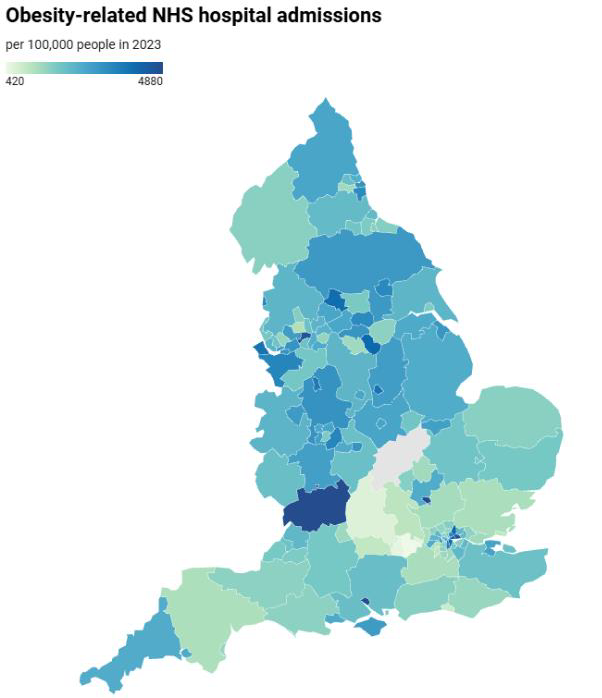
NHS Digital data for England shows that obesity-related NHS hospital visits are rising, with 1.2 million admissions recorded in 2023, more than double those recorded in 2016/17 (6).
Healthy weight is closely linked to levels of physical activity and diet. Many adults and children do not meet recommended levels of physical activity, and fewer than one in three adults eat the recommended five portions of fruit and vegetables each day. These behaviours are shaped by wider factors such as income, housing, transport, food environments and access to safe spaces for activity.
Our local picture
Data from the National Child Measurement Programme for 2024/25 (4) indicates that 21.5% of children in reception (aged 4-5 years) were overweight or living with obesity. This is 2% below the national average. Although, the proportion of those living with obesity is slightly above national average, at 10.6%.
By year 6 (aged 10-11 years) it is reported that 22.7% of children are living with obesity, compared to 22.2% across England. As well as 35.8% being overweight or living with obesity, compared to 36.2% in England.
The latest data on healthy weight for Reading (2023/24) indicates that adults are above the national average. Data shows that adults are 2.9% lower for overweight and 0.6% lower for obesity, respectively in England (Public Health Profiles, Fingertips).
However, those living in the most deprived communities were the most affected by overweight and obesity, highlighting the presence of inequalities.
Factors influencing obesity
Obesity and overweight are driven by a complex mix of factors, including high consumption of energy-dense foods and low levels of physical activity. These behaviours are influenced by environmental, social, commercial and biological factors, such as inherited risk, long-term health conditions and some medications. Other contributing factors that may increase the risk of living overweight or with obesity include smoking, harmful alcohol use, poor oral health, and diets low in fruit and vegetables. We also know that obesity is more common in deprived areas, highlighting the need for systemic change (12 – 14).
The “obesogenic” environment – where food and built environments make healthier choices harder – plays a significant role. This includes limited access to affordable healthy food, widespread marketing of less healthy options, and poor or limited walking and cycling infrastructure. Supporting healthy weight across the life course therefore requires a whole-systems approach, with coordinated action across communities, local government and partner organisations.
While understanding the full impact of these factors can be challenging, as not all are routinely measured. However, the data below provides a snapshot of key influences on obesity.
Obesity both reflects and reinforces existing health inequalities. Rates of overweight and obesity are consistently higher in more deprived communities and among some population groups, driven by unequal access to healthy food, safe spaces for physical activity, stable income and supportive services. These inequalities often emerge early in life and widen over time, contributing to poorer health outcomes, reduced quality of life and increased demand on health and care services. Addressing obesity is therefore a key opportunity to reduce health inequalities and support fairer outcomes across the life course (12 – 14).
Key statistics relating to overweight and obesity
Many people are not eating a balanced, nutritious diet. Only 28.7% of adults in Reading meet the recommended five portions of fruit and vegetables a day, highlighting poor diet quality across the population (5).
Local environments do not always support active travel. The Council’s Transport Strategy recognises that streets and public spaces need improvement to better support walking, cycling and independent mobility (12).
The local food environment strongly shapes food choice. There were 244 fast food outlets in Reading in 2024. The rate of fast-food outlets locally was 136.9 per 100,000, significantly higher than the rates in the South East (91.7) England (115.9 per 100,000) (9).
Obesity affects wellbeing, productivity and quality of life. It contributes to reduced productivity (presenteeism), higher sickness absence, premature ill health and early mortality.
More support is required to achieve activity levels. 17.2% of adults (around 29,000 residents) do less than 30 minutes of physical activity a week, increasing their risk of long-term health conditions (7).
Obesity risk is influenced by biology as well as behaviour. Genetic susceptibility, long-term health conditions and some medications increase the likelihood of weight gain, particularly when combined with an unhealthy environment.
Obesity is more common in more deprived communities. Data shows that people living in more deprived areas of Reading face greater barriers to healthy eating and physical activity, contributing to health inequalities (2)(3).
Healthy weight challenges begin early in life. In Reading, 35.8% of children in Year 6 (ages 10–11) are overweight or living with obesity, reflecting a sharp increase from early childhood and highlighting the importance of early and sustained prevention (4).
Taking action
Because these influences are interconnected, supporting healthy weight requires more than individual behaviour change. It requires coordinated action to create environments, services and systems that make healthier choices easier and reduce inequalities.
Nationally, policy direction is increasingly focused on prevention, whole systems approaches, neighbourhood health models and closer integration between local authorities, the NHS and the voluntary and community sector.
Locally, Reading is aligning with this direction through needs assessments, data-led prioritisation and the development of this Whole Systems Approach to Healthy Weight Strategy. Existing community, health and wellbeing services provide a strong foundation on which further coordinated, place-based action can be built.
Together, these approaches, seen both at a national and local level, signal a shift towards coordinated, place-based action to prevent excess weight and support long-term health and wellbeing.
Developing this strategy
Reading’s Whole Systems Approach to Healthy Weight Strategy (2026-2036), has been developed collaboratively through a co-design process, using a whole-systems approach. Thanks are given to all the stakeholders and individuals who contributed to this strategy.
Our strategy is informed by the Whole Systems Approach to Obesity (OHID, 2019) (12) using key insights from the Foresight Report on Tackling Obesities (Government Office for Science, 2007) (19), and the Reading Healthy Weight Needs Assessment (2023) (8).
Our approach included a comprehensive review of existing data and learning from previous strategies, alongside insights gathered through cross-sector stakeholder workshops and detailed consultations with sector experts. The work was supported and overseen by a dedicated task and finish group, including representatives from the county’s Health and Wellbeing Board.
This approach reflects the complexity of obesity and its causes. It brings together system-wide and community insights from across Reading to understand the challenge, assess how the local system currently operates, and identify opportunities for change.
The actions within this strategy have been co-developed and collectively agreed. Through this shared commitment, stakeholders will work together to ensure actions are coordinated rather than isolated, maximising impact and supporting healthier weight outcomes.
Note: A full list of contributing organisations and individuals is provided in Annex 1
Our vision and values
In Reading, partners across health, care, education, planning, and the voluntary sector recognise the need for collective action to create those supportive conditions to support more people to live healthier lives and have co-developed a vision for the Whole Systems Approach to Healthy Weight Strategy (2026-2036).
Our vision encapsulates the shared view that, in order to achieve sustainable change, the focus of our collective actions needs to be on creating the conditions for change, developing and refining the collaborative systems that operate across the region, and enabling more people to lead healthier lives.
In order to develop strong, sustainable relationships it has been recognised and agreed, by the stakeholders that support the development of our strategy, that three key values should guide our ways of working.
- Vision and purpose: We will work towards our shared vision, seeking opportunities to strengthen partnerships and collaborate to achieve meaningful, sustained change across our system.
- Culture and communication: We will value inclusion and co-production in every decision we make, communicating with openness, clarity, and transparency to create space for honest dialogue and constructive challenge.
- Action and support: We will act with intent, using available evidence, expertise, and assets to make a difference. We will demonstrate accountability and celebrate progress together.
Our strategic framework
The following pages contain our strategic framework which sets out key information associated with our delivery of the Whole System Healthy Weight Strategy (2026-2036). The framework includes:
- ten strategic commitments that form the foundation of our strategy
- a series of outcome-focused areas for action connected to each commitment
- a detailed implementation plan designed to enable a coordinated approach to delivery
Together, the information within the framework applies the principles of a whole-systems approach and provides a clear focus for how we plan, invest, and deliver. This ensures shared accountability and supports continuous improvement.
Strategic commitments
1. Leadership and governance
Creating a strong and accountable system that drives collective ownership and strategic coordination.
Outcome-focused actions
Delivering clear and transparent governance for healthy weight action with shared accountability across all sectors.
Facilitating collective system leadership at every level supports sustained, long-term commitment.
Striving to embed healthy weight as a strategic priority across public, voluntary, and private partners.
2. Policy
Developing local and regional policy environments that enable healthy living and equitable opportunities for health weight.
Outcome-focused actions
Striving to ensure that “Health in All Policies” underpins decisions on transport, housing, planning, and food environments.
Aligning local frameworks with recognised national strategies, showcasing local application and impact.
Promoting prevention, reducing inequalities, and addressing commercial, social, and economic determinants.
3. Commissioning
Coordinating investment and service design that prioritises prevention, long-term impact, and equality of access.
Outcome-focused actions
Ensuring that commissioning decisions are joined-up, evidence-based and help to reshape the environments and conditions influencing healthy weight.
Prioritising prevention, early intervention, and long-term outcomes over short-term fixes, ensuring services address the wider determinants of health.
Striving for co-commissioned, and where possible co-delivered services to create consistent, equitable access to supportive environments.
4. Partnerships
Strengthening multi-sector relationships with the Reading Food Partnership and others, to enable joined-up delivery and shared accountability.
Outcome-focused actions
A connected local system is operating with clear priorities and shared outcomes understood by all stakeholders.
Developing and maintaining trusted partnerships with communities, schools, and businesses create shared ownership of results.
Leveraging cross-sector collaboration to enhance the strengths of statutory, voluntary, and community organisations.
5. Community-involvement and co-design
Enabling residents to shape and lead change within their own communities.
Outcome-focused actions
Co-designing interventions with people with lived experience, and using insights to influence decision making processes.
Making local environments safer, more appealing and conducive to healthy choices.
Targeting resources are to reduce inequality in access and opportunity.
6. Activation
Delivering coordinated, practical action through sustainable resources, shared assets and supportive environments.
Outcome-focused actions
Creating connected, inclusive services that help people to develop and maintain a healthy weight.
Creating environments within local communities to make healthy choices easier, safer, and appealing.
Targeting resources to reduce inequality in access and opportunity.
7. Technology and innovation
Harnessing innovations in practice and technology to strengthen reach, equity, insight, and impacts across the system.
Outcome-focused actions
Enhancing access to services, participation, and coordination through exploring digital innovation.
Enabling safe and secure data sharing to support insight-led developments in practice and service delivery.
Exploring the use of technology to support inclusion, innovation, and healthier environments.
8. Workforce development
Equipping everyone who works with people with the confidence and skills to play their part in creating healthier environments and supporting people to maintain a healthy weight.
Outcome-focused actions
Creating a confident, informed, and connected workforce, equipped to influence environments and reduce inequalities.
Creating and embedding healthy weight and behaviour change into training and CPD.
Facilitating shared learning opportunities to support consistent, compassionate, stigma-free practice.
9. Advocacy, education and communications
Providing inspiring, inclusive, and evidence-based communication that builds understanding, reduces stigma, and encourages collective action.
Outcome-focused actions
Creating visible and accessible communication channels for sharing information and learning across system stakeholders.
Developing clear evidence-based messages and campaigns to help people and professionals to understand the benefits of healthy living and how to access support.
Supporting policymakers, practitioners and stakeholders recognise their role in shaping healthy environments.
10. Monitoring, evaluation and learning
Building an intelligent, adaptive system that learns from data, evidence, and lived experience to drive continuous improvement.
Outcome-focused actions
Creating system learning processes to maintain high quality decision-making, address inequalities and improve the delivery of services.
Identifying a consistent set of data, collated across all partners through a centralised system and practical tools.
Utilising credible evidence, including lived experience and views from the community to show our impacts.
Monitoring, evaluation and learning
Progress against the Healthy Weight Strategy (2026–2036) will be monitored and evaluated using a whole-systems, evidence-informed approach, ensuring that actions remain focused on what delivers the greatest benefit for Reading’s communities.
Our approach to monitoring and evaluation
The Council will use a Multi-Criteria Decision Analysis (MCDA) approach, as recommended by national government, to support transparent and consistent decision-making. This will help all stakeholders to:
- Assess progress against agreed outcomes
- Prioritise actions based on impact, need, feasibility and value for money
- Identify where changes or additional support are required
What we will measure
Progress will be tracked through a combination of:
- Population-level indicators, including excess weight prevalence, physical activity levels and diet-related measures, using national and local datasets.
- Service and programme data, such as participation, reach, uptake and engagement across communities and settings.
- Inequalities analysis, to understand who is benefiting, who is not, and where action is needed to reduce gaps in outcomes.
- Lived experience and qualitative feedback, ensuring that the voices of children, young people, adults and families shape ongoing delivery and improvement.
Accountability and governance
- Each action within the implementation plan will have a clearly defined owner, responsible for delivery and reporting.
- Delivery responsibility will sit with the relevant partner organisations or teams, reflecting the system-wide nature of the strategy.
- The Health and Wellbeing Board will oversee overall progress, receive regular updates, and provide strategic direction
- The Director of Public Health, supported by the Public Health Commissioner, will lead the governance process and ensure robust reporting.
Using learning to drive improvement
Monitoring and evaluation will not be a one-off activity. Findings will be used to:
- Inform annual reviews of the action plan
- Support continuous improvement in delivery
- Ensure resources are focused on actions that deliver the greatest impact
- Adapt the strategy over time in response to evidence, learning and local need
This approach will ensure the Whole System Healthy Weight Strategy (2026-2036), remains achievable, measurable, innovative and responsive, while supporting long-term improvements in diet, physical activity and healthy weight outcomes across Reading.
Appendices
1. Acknowledgements
We would like to thank the following individuals and organisations for their time, expertise and contributions to the development of the Whole System Healthy Weight Strategy (2026-2031).
Allen, Jemma – Better GLL
Allchin, Charlotte – Green Health Thames Valley
Batool, Nagina – Together for Mental Health
Beer, Steve – Better GLL
Bennett, Dr Trisha – Whitley Community Development Association
Boon, Alice – Reading Borough Council – Brighter Futures for Children
Bradbeer, Jane – University of Reading
Bridgeman, Romona – Reading Families Forum
Burfoot, Ben – Reading Borough Council
Burrows, Kirstie – Berkshire Healthcare NHS Foundation Trust
Crispin, Nina – Reading Borough Council – Public Health Team
Daniel, Alenka – Blue Lozenge
Eden, Cllr. Rachel – Reading Borough Council
Hogarth, Selina – Green Health Thames Valley
Holland, John – Reading Borough Council
Holman, Anu – Integrated Care Board
Horton-Baker, Nigel – Reading’s Economy & Destination Agency
Jones, Carolyn – Berkshire Healthcare NHS Foundation Trust
Kinghorn, Emma – Reading Borough Council
Knight, Becky – Reading Borough Council – Active Reading
Lupai, Sarah – Royal Berkshire Hospital
Maimo, Mary – Reading Borough Council – Public Health Team
Manzoor, Dr Ahmed – HIGOE Ltd
Mathew, George – ACRE
McIntosh, Georgia-Mai – The Mustard Tree
Murphy, Helen – Reading Voluntary Action
Nicholson, Beverley – Reading Borough Council – Commissioning and Transformation
Northcote, Joe – Reading Borough Council
Nyeke, Amanda – Reading Borough Council – Public Health Team
Payton, Alison – ReadiFood
Pearce, Matt – Director of Public Health, Reading & West Berkshire
Prendiville, Simone – Weller Centre
Puranik, Dr Manik – University of Reading
Roberts, Graham – Ethical Reading
Rush, Anita – NHS Berkshire West
Shepherd, Katherine – The Mustard Tree
Sharma, Nisha Tiwari – Rushmoor Health Living
White, Dayna – Reading Borough Council – Public Health Team
Whiffin, Kerry – Working Together Group
Williams, Michelle – Reading Borough Council – Children’s Centre Manager
Wagstaff, Carol – University of Reading
Zischka, Dr Lorna – University of Reading – Whitley Community Development Association
2. Glossary
Co-design Co-design is a collaborative approach to developing strategies, services or actions by working alongside people with lived experience and system partners, helping to ensure solutions are inclusive, relevant and more likely to be effective.
Commercial Determinants of Health The commercial determinants of health describe how commercial activities, such as food production, marketing and pricing, influence health behaviours and outcomes, including the promotion and availability of less healthy food and drink options.
Health Inequalities Health inequalities are avoidable and unfair differences in health outcomes between population groups, often linked to factors such as deprivation, ethnicity, disability, age and place.
Health in All Policies (HiAP) Health in All Policies is an approach that integrates health and wellbeing considerations into decision-making across all policy areas, recognising that sectors such as transport, planning, housing and education influence healthy weight and wider health outcomes.
Joint Strategic Needs Assessment (JSNA) A JSNA is a statutory, evidence-based assessment of the current and future health, wellbeing and social care needs of the local population. It brings together local data, intelligence and insights to inform priority-setting, commissioning and strategic planning across the local system.
Life Course Approach A life course approach recognises that health outcomes are shaped by experiences across the whole of life, from before birth through childhood, adulthood and later life, and that early intervention and sustained support are essential to maintaining a healthy weight.
Multi-Criteria Decision Analysis (MCDA) An MCDA is a structured, evidence-based approach used to compare and prioritise options by assessing them against multiple agreed criteria, supporting transparent and informed decision-making across a system.
National Child Measurement Programme (NCMP) The NCMP is a national programme that measures the height and weight of children in Reception and Year 6 in state-maintained schools in England, providing data to track trends in childhood overweight and obesity and inform local action.
Obesogenic Environment An obesogenic environment describes physical, social and commercial conditions that make it harder to eat well and be physically active, such as limited access to affordable healthy food, high densities of fast-food outlets, and poor walking and cycling infrastructure.
Physical Activity Inactivity In this strategy, physical inactivity refers to achieving less than 30 minutes of moderate physical activity per week, a level associated with a significantly increased risk of long-term health conditions.
Population-level Indicators Population-level indicators are measures used to track health outcomes and behaviours across a whole population, such as excess weight prevalence, physical activity levels and dietary patterns, rather than individual outcomes.
Prevention Prevention refers to actions taken to reduce the risk of overweight and obesity before they develop or worsen, including early intervention, creating supportive environments and addressing the wider determinants of health.
Wider Determinants of Health The social, economic and environmental conditions that influence health, including income, education, housing, transport, food access and employment. These determinants play a significant role in shaping healthy weight outcomes.
3. Sources
The following sources and publications informed the development of this strategy and provide further context and evidence to support the approach taken.
National and local health data
- Office for Health Improvement and Disparities – Public health profiles 2026 https://fingertips.phe.org.uk/
- NHS Digital (2024). Health Survey for England 2022: Part 2 – Adult overweight and obesity. Available at: https://digital.nhs.uk/data-and-information/publications/statistical/health-survey-for-england/2022-part-2/adult-overweight-and-obesity
- NHS Digital (2024). Health Survey for England 2022: Part 2 – Children’s overweight and obesity. Available at: https://digital.nhs.uk/data-and-information/publications/statistical/health-survey-for-england/2022-part-2/childrens-overweight-and-obesity
- Office for Health Improvement and Disparities (OHID) (2025). Fingertips: National Child Measurement Programme – Year 6 overweight and obesity, Reading. Department of Health and Social Care. Available at: https://fingertips.phe.org.uk/profile/national-child-measurement-programme
- Office for Health Improvement and Disparities (2024). Fingertips: Obesity, physical activity and nutrition – Adults eating 5 a day. Department of Health and Social Care. Available at: https://fingertips.phe.org.uk/search/fruit
- NHS Digital (2024). Hospital Episode Statistics: Obesity-related hospital admissions, England. https://digital.nhs.uk/data-and-information/publications/statistical/statistics-on-public-health/2023/introduction
- Office for Health Improvement and Disparities (2024). Fingertips: Physical activity – Adults classified as inactive (less than 30 minutes per week). Department of Health and Social Care. Available at: https://fingertips.phe.org.uk/profile/physical-activity
- Office for Health Improvement and Disparities (2024). Fingertips: Maternal obesity – Body mass index at antenatal booking. Department of Health and Social Care. Available at: https://www.gov.uk/government/statistics/child-and-maternal-health-profiles-december-2024-update
- Department for Levelling Up, Housing and Communities (2018). Fast food outlets: density by local authority in England. Available at: https://www.gov.uk/government/publications/fast-food-outlets-density-by-local-authority-in-england
Reading Borough Council strategies and assessments
- Reading Borough Council (2025), Healthy Weight Needs Assessment https://reading.berkshireobservatory.co.uk/wp-content/uploads/2025/03/Reading-Healthy-Weight-Needs-Assessment-2023-Clean-1.5-1.pdf
- Reading Borough Council (2025), State of the Borough Report – Joint Strategic Needs Assessment, https://reading.berkshireobservatory.co.uk/wp-content/uploads/2025/11/Reading-JSNA-Final.pdf
- Reading Borough Council (2023) Transport Strategy 2040 https://www.reading.gov.uk/vehicles-roads-and-transport/transport-strategy/reading-transport-strategy-2040/reading-transport-strategy-2040-draft-for-consultation-june-2023/
- Reading’s 2050 Vision – https://www.visit-reading.com/business/sustainable-future/reading-2050-vision
- Frontier Economics (2025). The economic and productivity costs of obesity and overweight in the UK. Commissioned by Nesta. Frontier Economics. https://www.frontier-economics.com/uk/en/news-and-insights/news/news-article-i21658-the-economic-and-productivity-costs-of-obesity-and-overweight-in-the-uk/
- Office for Life Sciences, Department of Health and Social Care and Department for Science, Innovation and Technology (2025). Obesity Healthcare Goals. GOV.UK. Available at: https://www.gov.uk/government/publications/life-sciences-healthcare-goals
Whole systems approach
- Michie, S., van Stralen, M. M. and West, R. (2011). The Behaviour Change Wheel: A new method for characterising and designing behaviour change interventions. Implementation Science, 6, 42. https://doi.org/10.1186/1748-5908-6-42 PubMed+2ResearchGate+2
- Public Health England. (2019). Whole Systems Approach to Obesity: A guide to support local approaches to promoting a healthy weight. PHE publications gateway number: GW-534. https://www.gov.uk/government/publications/whole-systems-approach-to-obesity GOV.UK+1
NICE guidance
- National Institute for Health and Care Excellence (NICE). Preventing excess weight gain (NG7). 2015. https://www.nice.org.uk/guidance/NG7
- NICE. Overweight and obesity management (NG246). 2025. https://www.nice.org.uk/guidance/NG246
- NICE. Obesity: working with local communities (PH42). 2012. https://www.nice.org.uk/guidance/PH42
- NICE. Obesity: identification, assessment and management (NG146). 2023. https://www.nice.org.uk/guidance/ng146
Addressing wider determinants of health
- Institute of Health Equity. (2020). Health equity in England: The Marmot Review 10 years on. https://www.health.org.uk/publications/reports/the-marmot-review-10-years-on
Life course approach
- Public Health England. (2019). Health across the life course: applying a life course approach to public health. https://www.gov.uk/government/publications/health-across-the-life-course-applying-the-life-course-approach-to-public-health
- Government Office for Science (2007) Tackling obesities: Future choices – Project report. London: Government Office for Science. Foresight Report on Tackling Obesities (Government Office for Science, 2007)
Health in All Policies (HiAP)
- Local Government Association (LGA). (2016). Health in All Policies: A manual for local government. https://www.local.gov.uk/publications/health-all-policies-manual-local-government
- Department of Health and Social Care / PHE. (2016). Local wellbeing, local growth: Adopting Health in All Policies. https://www.gov.uk/government/publications/local-wellbeing-local-growth-adopting-health-in-all-policies
Behaviour change foundations (COM-B Model)
- Michie, S., van Stralen, M. M. and West, R. (2011). The Behaviour Change Wheel: A new method for characterising and designing behaviour change interventions. Implementation Science, 6, 42. https://researchgate.net/…/The-COM-B-System-of-Behaviour-Change-Properties-Problems-and-Prospects ResearchGate+1
Last updated on 10/08/2026
Whole Systems Approach to Healthy Weight Strategy 2026 – 2036